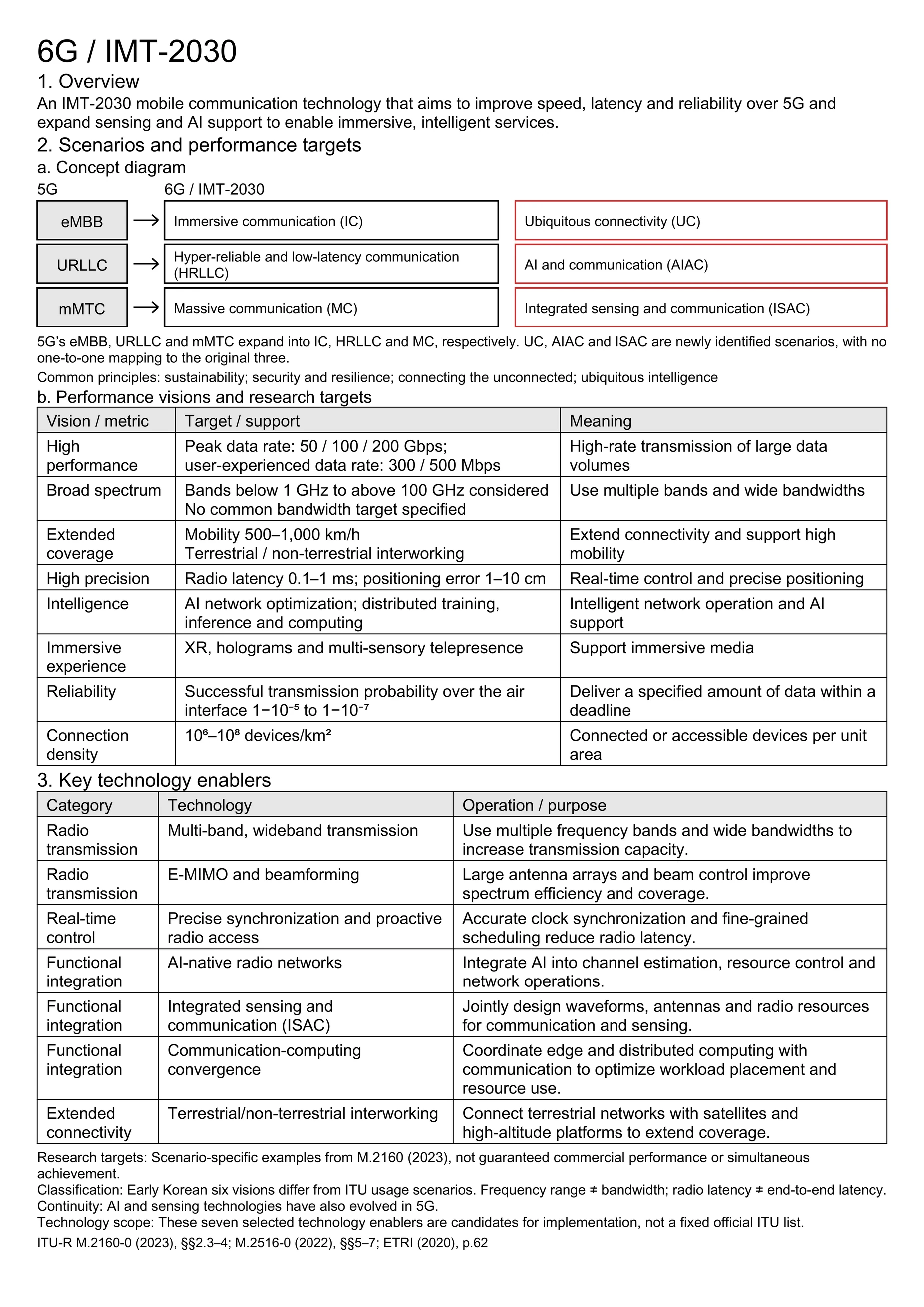
Definition
An IMT-2030 mobile communication technology that aims to improve speed, latency and reliability over 5G and expand sensing and AI support to enable immersive, intelligent services.
Six usage scenarios
The three 5G scenarios evolve as eMBB → immersive communication (IC), URLLC → hyper-reliable and low-latency communication (HRLLC), and mMTC → massive communication (MC). Ubiquitous connectivity (UC), AI and communication (AIAC), and integrated sensing and communication (ISAC) are three newly identified scenarios, not one-to-one counterparts of the original three.
- Immersive communication (IC)
- Immersive media and real-time interaction
- XR, holographic meetings and remote presence
- Hyper-reliable and low-latency communication (HRLLC)
- Reliable delivery within a specified deadline
- Synchronized industrial robots and power-grid control
- Massive communication (MC)
- Connect very large numbers of sensors and devices
- Smart cities and large-scale environmental sensing
- Ubiquitous connectivity (UC)
- Extend access to unconnected and underserved areas
- Connectivity in remote and mountainous areas
- AI and communication (AIAC)
- Support distributed AI training, inference and computing
- Collaborative AI computing across devices and servers
- Integrated sensing and communication (ISAC)
- Sense object positions, motion and surroundings
- Detect and track vehicles or pedestrians; monitor the environment
Common principles: sustainability; security and resilience; connecting the unconnected; ubiquitous intelligence
Performance visions and research targets
- High performance: Peak data rate: 50 / 100 / 200 Gbps;
user-experienced data rate: 300 / 500 Mbps - High-rate transmission of large data volumes
- Broad spectrum: Bands below 1 GHz to above 100 GHz considered
No common bandwidth target specified - Use multiple bands and wide bandwidths
- Extended coverage: Mobility 500–1,000 km/h
Terrestrial / non-terrestrial interworking - Extend connectivity and support high mobility
- High precision: Radio latency 0.1–1 ms; positioning error 1–10 cm
- Real-time control and precise positioning
- Intelligence: AI network optimization; distributed training, inference and computing
- Intelligent network operation and AI support
- Immersive experience: XR, holograms and multi-sensory telepresence
- Support immersive media
- Reliability: Successful transmission probability over the air interface 1−10⁻⁵ to 1−10⁻⁷
- Deliver a specified amount of data within a deadline
- Connection density: 10⁶–10⁸ devices/km²
- Connected or accessible devices per unit area
Key technology enablers
- Multi-band, wideband transmission
- Radio transmission: Use multiple frequency bands and wide bandwidths to increase transmission capacity.
- E-MIMO and beamforming
- Radio transmission: Large antenna arrays and beam control improve spectrum efficiency and coverage.
- Precise synchronization and proactive radio access
- Real-time control: Accurate clock synchronization and fine-grained scheduling reduce radio latency.
- AI-native radio networks
- Functional integration: Integrate AI into channel estimation, resource control and network operations.
- Integrated sensing and communication (ISAC)
- Functional integration: Jointly design waveforms, antennas and radio resources for communication and sensing.
- Communication-computing convergence
- Functional integration: Coordinate edge and distributed computing with communication to optimize workload placement and resource use.
- Terrestrial/non-terrestrial interworking
- Extended connectivity: Connect terrestrial networks with satellites and high-altitude platforms to extend coverage.
- Research targets
- Scenario-specific examples from M.2160 (2023), not guaranteed commercial performance or simultaneous achievement.
- Classification
- Early Korean six visions differ from ITU usage scenarios. Frequency range ≠ bandwidth; radio latency ≠ end-to-end latency.
- Continuity
- AI and sensing technologies have also evolved in 5G.
- Technology scope
- These seven selected technology enablers are candidates for implementation, not a fixed official ITU list.